New Lent email devotionals available at Bible Gateway

March 4th, 2011

Looking for some Lent devotional reading as Easter approaches? Our sister site Bible Gateway has just launched two new email devotionals centered around Easter: a read-through-the-Gospels Bible reading plan and a Lent devotional email. Both begin on Ash Wednesday (March 9) and run through Easter, and both are aimed at helping you focus on Jesus during the Easter season.

Take a look—and if you have a favorite Lent/Easter devotional to recommend, let us know in the comments below!

Related Topics: , , ,

A secular case for tithing?

March 2nd, 2011

The “The New Tithe” (below) was the winner of this year’s Project Reason video contest. Project Reason is “nonprofit foundation devoted to spreading scientific knowledge and secular values in society.”

The video light on hard facts and gets some fundamental things wrong about what most churches do with their money (ie it’s not all going to huge salaries and fancy buildings). For every church that misuses its money, there are thousands—if not more—who are transparent and responsible with their expenditures. All that said, I do think it’s interesting that someone would make a secular case for “tithing”:

I’d doubt this video will convince many Christians to stop giving to their church. Plus, as the blogger over at unreasonable faith points out in his thoughts on the New Tithe video, most tithing Christians find their local churches to be worthwhile endeavors.

However, it does make me wonder how people outside of my church perceive our churches. Should that change how we use our money? And thinking along those lines, are there guidelines for how a church should use its member’s tithes? Should 10% of everyone’s 10% go to missions for example?

Related Topics: , ,

Does “Christian outrage” work?

March 1st, 2011

Several years ago, when The Da Vinci Code first graced bookstore shelves, I remember becoming aware of it not through its publisher’s marketing campaign or by favorable word-of-mouth recommendations from its readers, but through articles written by Christians (including several well-known apologists) denouncing it. The message of those many Christian articles—some angry, others calm, but all concerned—was that The Da Vinci Code was a Serious Threat that Christians ought to pay attention to.

Did all that talking help readers understand the flaws in The Da Vinci Code? Or did it just inadvertently promote the book, providing fodder for endless “Da Vinci Code controversy” news reports and turning a mediocre thriller novel into a subject of discussion in countless Christian households?

That’s the question raised by Christopher Hays in “The Folly of Answering Fools” at at Christianity Today. It argues that Christians, when we jump on offensive or controversial books, films, and games, inadvertently just end up playing into their promoters’ hands. Call it the “Christian Streisand effect“: the louder you object to something, the more you call attention to its existence. Here’s how Hays puts it:

[I do not] aim to silence genuine criticisms of the church or preclude taking seriously how non-Christians perceive the world. But not every insult is serious.

What I am saying is much simpler: Let’s be more circumspect about what we pluck from the roiling waters of culture and bring to the world’s attention.

I think it’s safe to say that when promoters manufacture fake Christian outrage to draw attention to their product, it’s time to re-evaluate the value of “Christian outrage.”

But here’s the challenge: it’s really, really hard to not speak up when you see a book or movie spreading misinformation about Christianity. Is keeping silent when a book or pundit attacks the church prudent, or will it be seen as an admission of defeat? How do you tell when a book or product is serious enough to merit a public Christian response?

Do Christians have a lower rate of divorce than non-Christians?

February 24th, 2011

It’s common, in discussions about marriage, divorce, and family matters, to hear the claim that Christian marriages have the same divorce rate as non-Christian ones—the point being that Christians don’t have much of a leg to stand on when it comes to critiquing social policies related to marriage and family. But is that true, or just a myth that’s been repeated so many times we’ve accepted it?

Glenn Stanton has attracted attention over the last week with an essay claiming that Christians do, in fact, average a significantly lower divorce rate than non-Christians:

Professor Bradley Wright, a sociologist at the University of Connecticut, explains from his analysis of people who identify as Christians but rarely attend church, that 60 percent of these have been divorced. Of those who attend church regularly, 38 percent have been divorced.

Other data from additional sociologists of family and religion suggest a significant marital stability divide between those who take their faith seriously and those who do not.

Stanton makes it clear that it’s “serious Christianity” (church attendance and involvement, among other things) and not just “nominal Christianity” (saying you’re a Christian, but not doing anything to demonstrate it) that makes the difference.

That’s welcome news, if true. I don’t have any evidence to suggest this is or isn’t true, but it wouldn’t surprise me to hear that an oft-quoted “known fact” like this, almost always stated without citing any evidence, turns out to be untrue. But don’t use this in your social-policy discussions quite yet; at least one blogger finds Stanton’s essay unconvincing. The Confessing Evangelical blog thinks the lower divorce rates might just as easily be explained by other factors, not just “serious religious behavior:”

Most of the behaviours that Stanton attributes to “serious disciples” are likely to be associated with other behaviours or circumstances that may be shared by non-Christians. “Attending church nearly every week” and “praying privately and together” suggest a settled, stable family life, and a regular working pattern (no having to work shifts on Sunday, for example). “Reading their Bibles and spiritual materials regularly” suggests a certain level of literacy and of regularity of routine.

In short, what Stanton is describing is a happy, bourgeois family lifestyle in which people work regular hours, married couples spend significant quality time together (whether that’s praying together or just talking to one another), weekends are devoted to family activities (whether that’s going to church or to the park) and individuals have the time and mental energy to read books and think about their lives.

Without having read the sources from which Stanton’s argument is derived, I’m inclined to err on the side of caution and be skeptical of his claims. But to be honest, I was struck less by the question of who has the lower divorce rates than by the most optimistic Christian divorce rate cited: 38%. That number might be 5% or 25% lower than the non-Christian divorce rate, but it’s still a horrifyingly high percentage. When it comes to promoting healthy families and marriages, we’ve got our work cut out for us no matter who’s right.

Related Topics: , ,

The Semantic Game of Women in Ministry

February 23rd, 2011

Out of Ur has begun posting a series of videos about the different viewpoints on women in ministry. The first video from Rose Madrid-Swetman is posted below:

The thing that stuck out to me most from this video was Madrid-Swetman’s point about how many churches sidestep the heart of the issue by wrapping it up in semantics. As she says, women can hold the title of “Coordinator,” but if a man were to have the same position and responsibility they’d be called the “Pastor.” Worship Coordinators are functionally the same as Worship Pastors; same for Children’s Coordinators and Pastors.

It’s inconsistent for churches to hide behind word games in order to appear as if they’re upholding their theological views on gender roles in the church. If you’re going to be a complementation church, I think you have to be consistent in the way you describe those roles.

Related Topics: , ,

Do you make a point of patronizing Christian brands and businesses?

February 22nd, 2011

Have you ever seen local businesses with Christian symbols or other markers on display? Maybe it’s a fish sticker on the front door, or a stack of gospel tracts near the counter. Growing up in southern California, I always had fun looking for Bible verses hidden on the bottom of In-N-Out Burger soda cups.

I like seeing these little signs and symbols around town and knowing that I’m (probably) doing business with a fellow believer—even though there’s no guarantee that a self-identified Christian company is actually doing business in accordance with Christian values, I at least like to imagine that the person I’m doing business with is motivated by Christian values, not just the pursuit of profit.

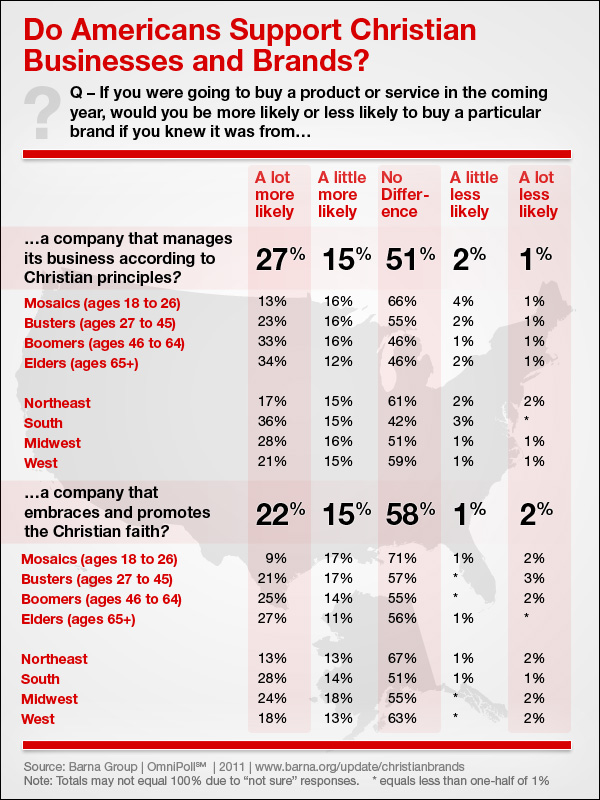
Do you care whether whether a business identifies itself as Christian? Does it make a difference to you if a company runs itself in accordance with Christian principles? A recent Barna poll asked that question; while the full report is worth reading, this chart sums it up nicely:

barna

The trends are pretty clear. The older you are, the more likely you are to go out of your way to support Christian businesses and brands. Southerners and Midwesterners are more likely to do so than their east- and west-coast counterparts. But ultimately, most Americans say that it doesn’t make a difference to them whether a business looks or acts Christian.

Where do you fit? All other things being equal, when it’s time for an oil change, do you bring your car to the business with a Christian fish on the window? Or does it really not matter to you?

Posture, location and prayer

February 18th, 2011

While there’s no perfectly “holy” posture and location for prayer, I think it’s obvious that both effect the experience of prayer. A prayer said out loud with your family while driving down the road is going to be much different than one said while laying facedown by yourself in a private space.

How has your physical posture and location affected your spiritual posture towards prayer, if at all?

Share your thoughts in the comments!

Related Topics: ,

Christians and the quest to influence culture through social media

February 17th, 2011

“How can Christians use social media to influence culture?”

I can’t tell you how many times I’ve heard variants of that question at Christian gatherings and conferences over the last decade. As blogging, social networking, Twitter, mobile texting, and other services cropped up in turn, Christians—always eager to share the Gospel with the world around them—have wondered how to “use” these “tools” to change culture for the better.

I’m certainly sympathetic to this general goal, but these phrases are clearly the vocabulary of the broadcast media era, when television and radio transmitted the Christian message to millions around the world, to great effect. But unlike traditional broadcast media, social media feels less like a tool that can be aimed in a particular direction, and more like a general background against which we go about our everyday lives and conversations. Now everyone is a broadcaster, and no central authority manages the message.

In the back of my mind, I’ve always wanted to ask, “Instead of trying to figure out a magic formula that will transform social media into the perfect evangelistic tool, why don’t you just be a Christian who participates in social media?”

These thoughts came to mind while reading a roundtable discussion about Christians, blogging, and the internet. Blogger Jared Wilson, asked “Can social media truly have a positive influence on Christianity?”, responded with this sharp insight:

Obviously I am interested in some level of influence, or else I wouldn’t post my thoughts in public forums for others to read. But the context of thinking of social media as a “tool” to influence others — and here I think of self-appointed marketing gurus, some of the pastorpreneurial tribe, and anybody who obsessively monitors their stats and rankings — seems so strange to me…

Can social media have a positive influence on Christianity? Yes, locally and worldwide. But probably not… in that sense of heavy influence. But social media edifies me when I’m reading the right people…. all of us here probably receive messages throughout the year from folks who say a particular post or tweet encouraged them, addressed some concern of the day, etc. So use of social media that glorifies God — whether it’s reveling in the gospel, reflecting on a Scripture, or just in the spirit of Christian camaraderie being silly among friends — can be a positive influence in someone’s need of the moment. Our days go by fast; our needs change. I would think a short-shelf-life medium like Twitter might be keenly appropriate for encouragement in that context.

When you approach blogging, Twitter, or other networking with this attitude, your social networks become an extension of your normal communication—which, if you’re a Christian, will be influenced by your faith and desire to share the Gospel. I think that’s a very practical way to “be a Christian online,” and is more likely to positively influence your “audience” than trying to implement a noble-sounding, but vague, media strategy. Among other things, it simply feels more authentic—who wouldn’t be a little suspicious upon learning that their Christian friends were trying to “use Facebook to reach” them?

Where have you seen Christians having a positive influence through blogging or social networking? Were those Christian influencers guided by a strategy, or simply “being Christians?”

Contemplating Winter

February 16th, 2011

Cold, wet and dark are three of my least favorite things, and winter has them in spades. This winter though, I’ve been attempting to find God’s handiwork in the season rather than just being upset that it’s not spring yet. Needless to say, it’s been a very enlightening experience.

Appreciation of Creation is a way in which we worship the Creator. It’s almost trivially easy to do in spring, summer and fall; the colors and smells draw us into a celebratory and worshipful mood. To find praise-worthy elements of winter has meant being purposeful about noticing the world around me.

One quick example: call me dense, but it took me until this winter to really realize how serene a heavy snowfall can be. There are few sensations as relaxing as standing in a freshly blanketed field looking around at the world covered in a white sheen. This year, the snow was even enough to force cities into a rare and well-needed quietude. Just being able to soak in the silence and sit in the awe of the expansiveness of God’s Creation has been wonderfully refreshing.

What about you? Do you take time to thank God for all of the seasons? Is there anything you find praise-worthy about winter?

Related Topics: , , , ,

Introverts and Extroverts at Church

February 15th, 2011

I’ve been slowly reading a book called Introverts in the Church by Adam S. McHugh. As an introvert myself, I’ve found it to be a fantastic book. Every few pages there’s some anecdote that has me nodding along and saying, “Yes! I’ve been there!” I’m also finding that whenever I mention this book in Christian company the introverts in the room start to perk up and want to know more.

One thing that this book is instilling in my heart is that the church direly needs people spanning the spectrum of personality type. Right now the Church—in the United States at least—seems to prize the extrovert personality as the one true personality type. From what we call the ideal pastor down to how we teach people to evangelize, it’s primarily an extroverts game. It’s a shame though because that philosophy in turn makes it harder for some of the Church’s members to feel they can utilize their gifts effectively for the kingdom.

I don’t have a grand conclusion (after all, I’m not done with the book), but I did want to ask a few questions while they’re fresh on my mind.

For everyone: think about how your church practices openness to the variety of personalities walking through the door. Take a basic example: the time before and after church. Do you create a place for the contemplative person to prepare for worship? Or is it set up like a mixer? (If you’ve never thought of this before, have you ever wondered why some portion of the congregation tends to show up late and leave early?)

For the introverts reading this: what are some ways you feel like the church has supported you? We could come up with negative stories all day long, but I think it’s important to call out ways in which the church has been successful.